
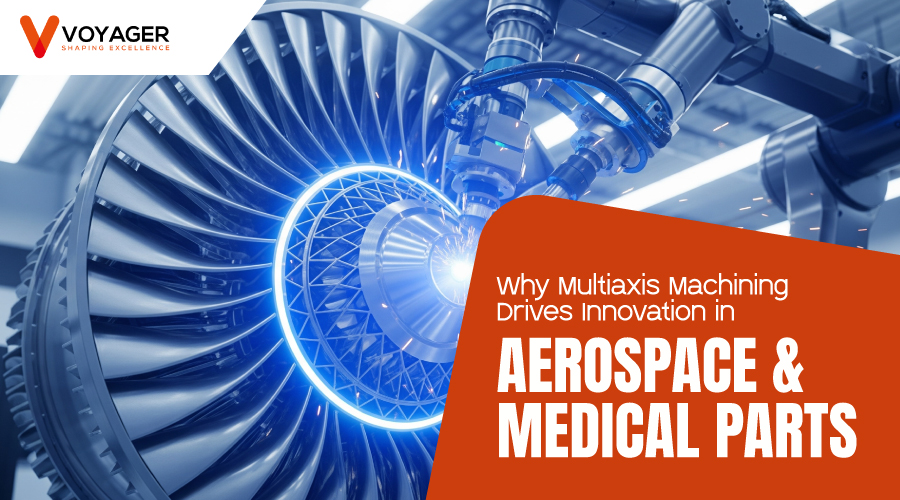
Multiaxis CNC machining is revolutionising the way precision aerospace & medical components are manufactured. By enabling complex geometries, superior surface finishes, and unmatched accuracy, this advanced machining process addresses the ever-increasing demands of high-tech industries. Companies like Voyager Engineering utilise multiaxis machining to produce intricate parts efficiently, thereby reducing errors and accelerating production timelines.
What is Multiaxis CNC Machining?
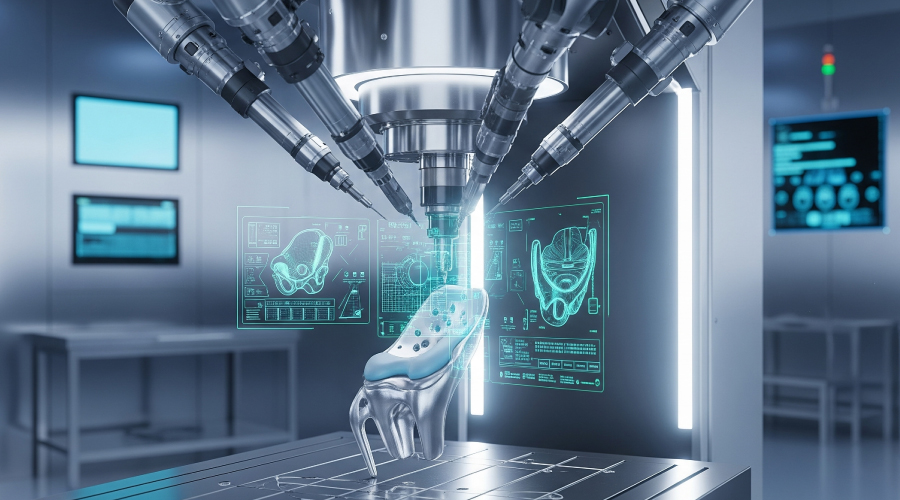
Multiaxis CNC machining refers to the use of computer-controlled machines that operate on more than three axes. Unlike traditional 3-axis machining, multiaxis systems—commonly 4-axis or 5-axis—allow simultaneous movements along multiple planes. This capability enables manufacturers to:
- Machine complex geometries in a single setup
- Reduce human error and repositioning requirements.
- Enhance overall precision and repeatability.
This technology is particularly valuable for industries where tolerances are tight and component complexity is high, such as aerospace and medical device manufacturing.
Transforming Aerospace Component Manufacturing
Precision aerospace & medical components demand extreme accuracy. Multiaxis CNC machining offers:
Handling Complex Geometries
Aircraft components, such as turbine blades, airfoils, and structural parts, often feature intricate shapes. Multiaxis machining enables engineers to produce these designs in a single continuous process, eliminating the need for multiple setups that can compromise quality.
Machining Advanced Materials
Materials like titanium, Inconel, and carbon fibre composites are challenging to machine. Multiaxis CNC systems provide consistent force control and optimal tool paths, ensuring high precision without material deformation.
Improving Efficiency and Reducing Lead Times
By reducing the number of setups and tool changes, multiaxis machining significantly cuts production time. Aerospace manufacturers benefit from faster prototyping and quicker delivery of mission-critical parts.
Advancing Medical Device Production
Medical devices, implants, and surgical instruments require exceptional precision and quality. Multiaxis CNC machining enhances medical manufacturing by:
Enabling Patient-Specific Components
Custom implants and surgical tools must be tailored to match the patient’s anatomy. Multiaxis machining allows for high-precision customisation without compromising structural integrity.
Achieving Superior Surface Finish
Smooth surface finishes reduce post-processing requirements, improving biocompatibility and longevity of medical implants.
Maintaining Regulatory Compliance
Strict regulatory standards in the medical industry demand precise dimensions and repeatability. Multiaxis machining ensures compliance with minimal deviations.
Why Multiaxis Machining is a Game-Changer
Multiaxis CNC machining is not just a manufacturing tool—it’s a driver of innovation. Key benefits include:
- Enhanced Accuracy: Multiaxis CNC machining produces aerospace and medical components with unmatched precision. Unlike traditional machining, which often requires multiple setups, multiaxis systems complete complex cuts in a single operation. This eliminates misalignment errors and ensures each component meets the stringent tolerances necessary for high-performance applications, from turbine blades to surgical implants.
- Reduced Errors: Human error and multiple part repositioning are significant causes of defects in manufacturing. Multiaxis machining significantly reduces these risks by simultaneously handling numerous axes. With fewer setups, the likelihood of mistakes decreases, resulting in higher-quality components and lower rates of rework. This reliability is essential for applications that cannot afford errors.
- Time Efficiency: By consolidating multiple operations into one setup, multiaxis CNC machining drastically cuts production cycles. Traditional manufacturing methods often took days to produce certain parts; today, the same part can be manufactured in hours and maintain the same quality. Faster machining translates to shorter lead times, quicker prototyping, and speedier delivery of aerospace and medical components—giving manufacturers a competitive edge.
- Cost Optimisation: The multiaxis machines are initially more expensive but decrease the overall production cost. Fewer setups, less material waste, and minimal post-processing result in both time and resource savings. Manufacturers can produce more parts in less time while maintaining superior quality, resulting in significant cost benefits over traditional methods.
Did you know? Many modern turbine blades and orthopedic implants could not be produced without multiaxis CNC machining due to their complex shapes and tight tolerances.
Conclusion
Multiaxis CNC machining is transforming the production of precision aerospace and medical components. By enabling complex designs, reducing lead times, and ensuring unmatched accuracy, it drives innovation and efficiency in high-tech manufacturing. For companies aiming to stay ahead in aerospace or medical device production, adopting multiaxis machining is no longer optional—it’s essential. With its expertise and advanced capabilities, Voyager stands as a trusted partner for businesses ready to embrace this future of manufacturing.
Next Step: Contact Voyager Engineering to explore how multiaxis CNC machining can enhance your manufacturing process and deliver parts with unmatched precision.
FAQs
Q1. What is multiaxis CNC machining, and how does it work?
Ans. Multiaxis CNC machining is a manufacturing process where a computer-controlled machine operates on more than three axes simultaneously. This enables the machining of complex part geometries in a single setup with high precision, thereby reducing errors and improving efficiency.
Q2. Why is multiaxis CNC machining necessary for aerospace components?
Ans. Aerospace components often feature complex geometries, and the materials from which they are made, such as titanium or Inconel, are challenging to manufacture. Multiaxis CNC machining ensures that these components are manufactured with high precision, tight tolerances, and minimal material waste, which is crucial for ensuring safety and optimal performance.
Q3. How does multiaxis machining benefit medical device manufacturing?
Ans. Multiaxis machining enables the production of custom implants and surgical instruments with exceptional precision and accuracy. It ensures smooth surface finishes, reduces post-processing, and maintains strict regulatory compliance for medical applications.
Q4. What industries benefit most from multiaxis CNC machining?
Ans. While aerospace and medical device manufacturing are primary beneficiaries, other industries, such as automotive, defence, and electronics, also utilise multiaxis CNC machining for producing complex and high-precision components.
Q5. What are the advantages of 5-axis over 3-axis machining?
Ans. 5-axis machining enables simultaneous movement along five axes, reducing the number of setups, improving surface finish, increasing accuracy, and allowing for the production of more complex geometries compared to traditional 3-axis machines.