
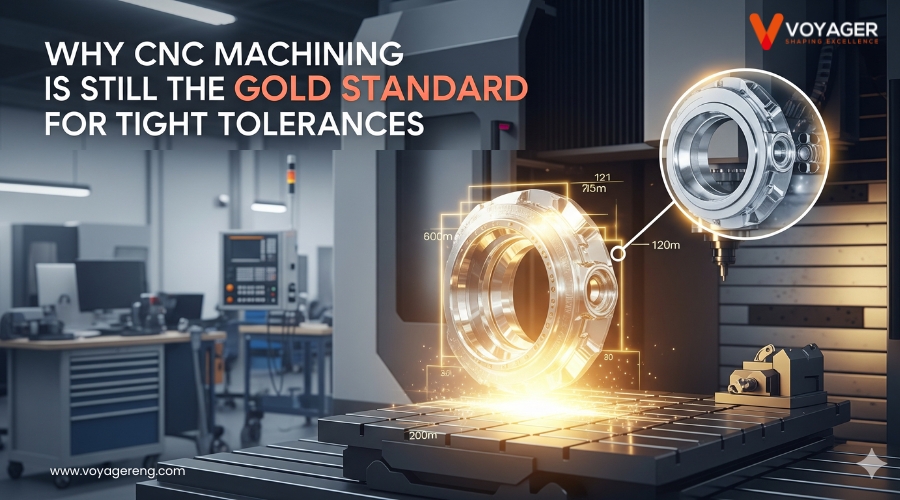
Precision isn’t just a technical term, it’s the invisible difference between a component that performs flawlessly and one that fails under critical conditions. A millimetre is sometimes the difference between the success or failure of a product in modern manufacturing. That’s why CNC machining tight tolerances remain essential, delivering unmatched accuracy that continues to outshine newer technologies. From aerospace to medical devices, industries that demand perfection still rely on CNC machining as their gold standard.
What Are Tight Tolerances and Why Do They Matter
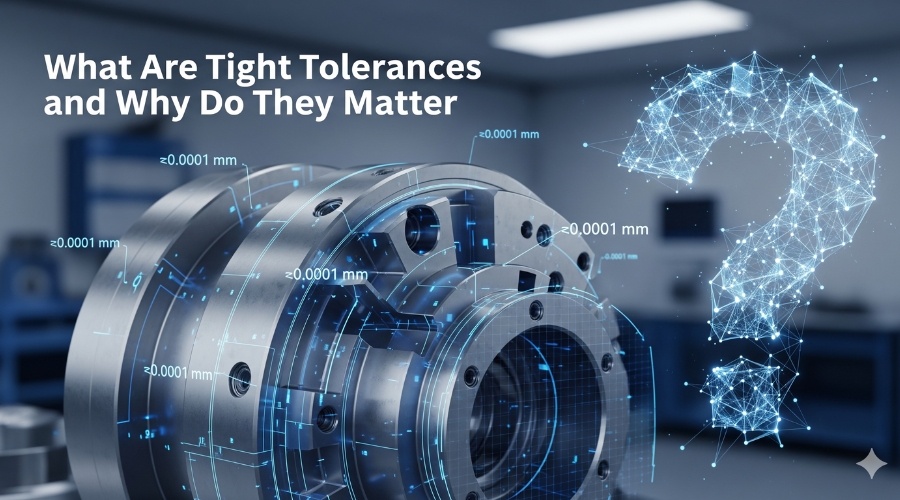
Tight tolerances define the maximum allowable deviation in a part’s dimensions. For instance, a tolerance of ±0.001 inches (±0.0254 mm) ensures parts fit precisely and perform reliably. These precise limits are critical in applications where minor deviations can lead to product failures, safety risks, or regulatory non-compliance.
Industries heavily dependent on tight tolerances include:
- Aerospace – Aircraft components must operate safely under extreme pressures and temperatures.
- Medical- Surgical equipment and implants require no margin of error to avoid complications.
- Electronics – Compact devices, such as smartphones and circuit boards, require precise dimensions for proper assembly.
- Automotive – Engine components and transmission parts rely on consistent tolerances to avoid performance issues.
Neglecting these tolerances can result in costly recalls, wasted materials, and even safety hazards.
Common Challenges in Achieving Tight Tolerances
Even with advanced CNC machinery, several factors make achieving tight tolerances challenging:
- Material Inconsistencies – Different batches or types of materials can exhibit varying behaviour under machining, which can affect the final dimensions.
- Thermal Expansion – Heat generated during machining can subtly alter dimensions, especially in metals.
- Machine Wear and Calibration – Regular maintenance and calibration are essential; even high-end machines lose precision over time.
- Tooling Limitations – Using worn or inappropriate cutting tools can prevent achieving desired tolerances.
- Environmental Factors – Vibrations, dust, and temperature fluctuations can impact machining accuracy.
Understanding these challenges is crucial for engineers seeking to implement tight-tolerance CNC machining effectively.
Why CNC Machining Tight Tolerances Excel
CNC machining is the most accurate manufacturing technique due to a few reasons:
- High Precision and Repeatability – CNC machines can reproduce identical parts hundreds or thousands of times without deviation.
- Automated Consistency – Computer-controlled processes eliminate human error, improving quality and reducing waste.
- Versatility Across Materials – CNC machines can handle a wide range of materials, including metals, plastics, composites, and more, while maintaining tight tolerances.
- Adaptability for Complex Designs – Intricate geometries and small features can be machined with precision that manual methods cannot match.
These advantages ensure that CNC machining remains the preferred method for applications requiring high accuracy.
Practical Tips to Optimise Tight Tolerances
Manufacturers can implement several strategies to maintain or improve tolerance precision:
- Regular Machine Calibration – Frequent calibration ensures machinery maintains its rated precision.
- Select Appropriate Materials – Materials with predictable machining behaviour reduce dimensional inconsistencies.
- Use Advanced Tooling Techniques – High-quality, properly designed cutting tools minimise errors.
- Control Environmental Conditions – Maintain environmental conditions such as temperature, humidity, and a vibration-free working environment.
- Implement Quality Monitoring – In-process inspections and metrology checks ensure components meet specifications before final assembly.
Even minor adjustments in processes or environment can significantly improve outcomes without dramatically increasing costs.
Cost vs. Benefit of Tight Tolerance CNC Machining
Achieving ultra-tight tolerances may raise production costs due to slower feed rates, specialised tools, and meticulous quality control. But the costs are paid off in the long term benefits:
- Reduced rework and scrap material
- Enhanced reliability and product performance
- Compliance with industry regulations
- Increased customer satisfaction
A balance between precision requirements and cost requirements enables the manufacturer to make decisions and stay profitable.
Future Outlook of CNC Machining in a High-Precision World
While technologies like 3D printing, laser cutting, and additive manufacturing have advanced, CNC machining remains indispensable for projects demanding CNC machining tight tolerances. Its unbeatable repeatability, control ,and flexibility give it the leading position as the technology of choice for industries where precision is at a premium. Manufacturers who combine CNC machining with smart process optimisations are best positioned to meet evolving high-precision requirements.
Conclusion
CNC machining continues to dominate the precision manufacturing landscape due to its ability to deliver CNC machining tight tolerances with unmatched accuracy, repeatability, and versatility. By understanding common challenges, applying practical tips, and weighing the cost-benefit balance, businesses can produce reliable, high-quality components. For expert CNC machining solutions and guidance, Voyagereng offers state-of-the-art services that meet the most stringent specifications.
Ensure your parts meet exacting standards. Partner with Voyagereng for precision CNC machining today!
FAQ’s
Q1: What are tight tolerances in CNC machining?
Ans: Tight tolerances are minimal allowable deviations in dimensions, often ±0.001 inches.
Q2: Which industries need tight tolerance CNC machining?
Ans: Aerospace, medical devices, electronics, and automotive sectors rely on tight tolerances.
Q3: How can manufacturers achieve consistent tolerances?
Ans: Regular calibration, proper material selection, advanced tooling, and controlled environments help maintain precision.
Q4: Is achieving tight tolerances expensive?
Ans: Costs can be higher, but benefits like reduced rework, regulatory compliance, and product quality usually justify it.
Q5: What is the future of CNC machining in face of the new technologies?
Ans: With its unmatched precision and repeatability, CNC remains the gold standard in high-precision manufacturing.